Test Management in the Cloud – The Hybrid Testing Illusion - Series 3/7
Blog from 3/31/2026
The Hybrid Testing Illusion: Cloud Control, On-Prem Reality
In Part 1, we examined how execution truth and reporting truth can diverge in hybrid SAP landscapes. We looked at the structural split between where automation runs and where governance decisions are made.
In Part 2, we explored the subtle operational signals that reveal this gap — and why it often persists for years without being addressed. The landscape appears connected. Reports are mostly accurate. Releases mostly succeed. The friction is tolerable.
Now we turn to the deeper structural issue behind this pattern.
The Hybrid Testing Illusion.
The Hybrid Testing Illusion describes a structural condition in which governance and reporting operate in the cloud, while automation execution remains on-prem — and dashboards create the perception of systemic control across both domains.
The illusion forms when organizations equate visibility with verification.
Modern cloud platforms such as SAP Cloud ALM, Xray, or Azure DevOps provide consolidated dashboards, centralized KPIs, and executive transparency. From a governance perspective, everything appears structured, measurable, and controlled. Test plans are visible. Coverage metrics are aggregated. Status indicators are aligned.
At the same time, automation engines such as Tricentis Tosca or Worksoft Certify continue to execute inside protected enterprise network zones — close to productive SAP systems. Latency constraints, security architectures, and regulatory requirements often prevent these execution environments from moving fully to SaaS.
This architectural split is not a flaw. It is often necessary.
The result is not dysfunction.
It is architectural asymmetry.
And asymmetry creates illusion.
Cloud-level dashboards tell a compelling story. They show high completion rates, strong automation coverage, full release readiness, and resolved critical defects. From a steering committee perspective, the conclusion seems obvious: testing is under control.
But that conclusion rests on an assumption that is rarely examined. It assumes that cloud-level reporting is structurally and directly derived from native execution events.
In hybrid SAP landscapes, this is frequently not the case.
Execution logs, runtime traces, validation artifacts, and technical context remain on-prem, where the automation engines actually run. What appears in the cloud is typically a summarized and transferred representation of those execution outcomes — enabled through status synchronization, API-based result transfers, batch updates, manual reconciliation steps, or artifact uploads.
The dashboard is not necessarily wrong. But it is mediated. And the illusion begins when mediation is mistaken for systemic binding. To understand this more clearly, we need to look at the underlying architecture.
A simplified hybrid model typically consists of three layers.
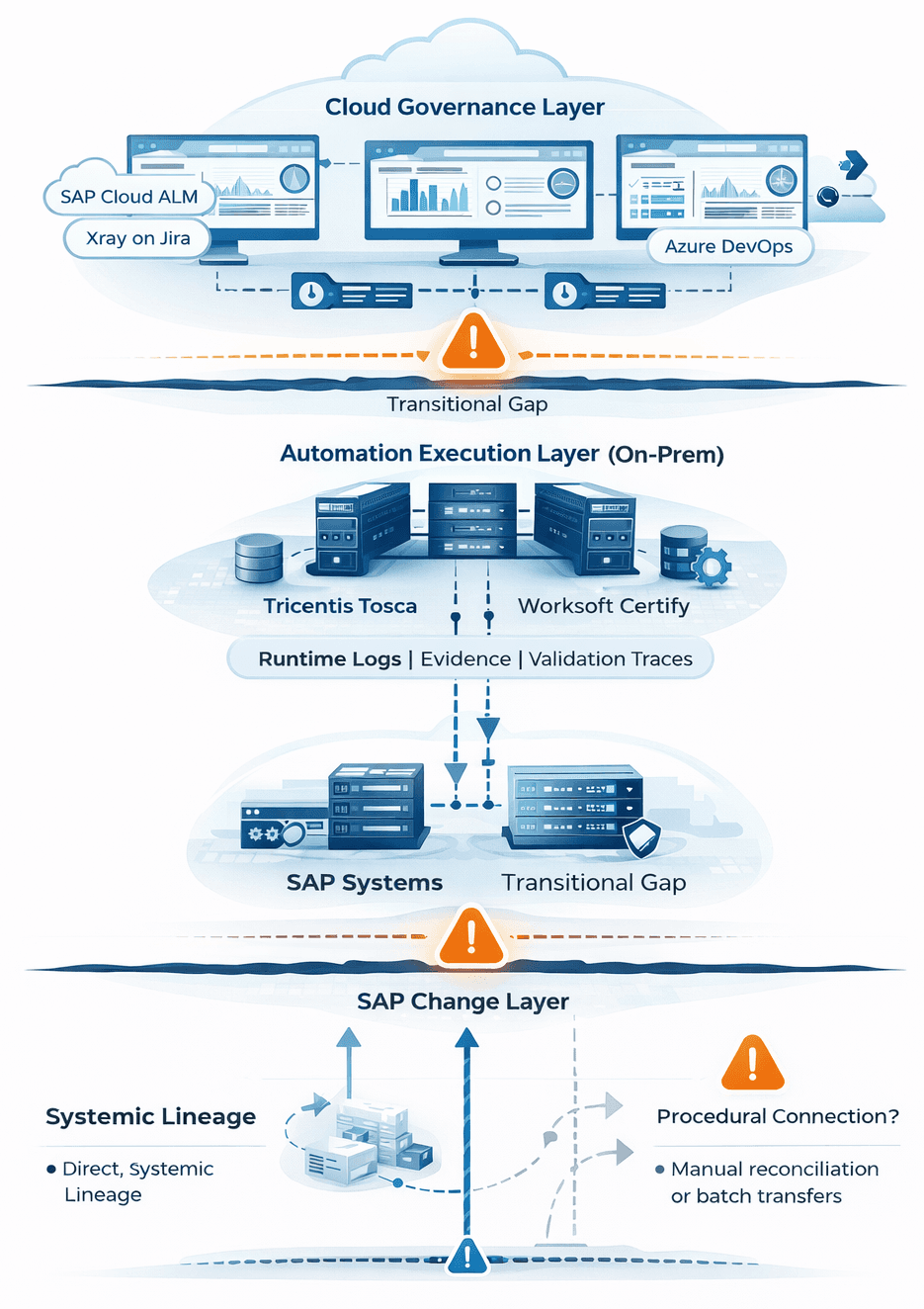
Layer 1:
At the foundation sits the SAP Change Layer: transports (CTS), configuration changes, and functional enhancements that modify business processes.
Layer 2:
Above it operates the Automation Execution Layer on-prem, where Tosca or Worksoft execute test cases and generate runtime logs, evidence, and validation traces locally against SAP systems.
Layer 3:
At the top resides the Cloud Governance Layer, where SAP Cloud ALM, Xray, or Azure DevOps manage test plans, aggregate test runs, calculate coverage KPIs, and provide executive dashboards.
Each of these layers performs its role effectively within its own boundary.
The structural question is not whether they work.
It is whether they are inherently bound.
Is there a direct, systemic lineage from an SAP transport to the automation execution that validates it — and from that execution event to the cloud-based governance decision

In many hybrid landscapes, the answer is not structural. It is procedural.
Integration ≠ Orchestration
Most organizations react to the hybrid split pragmatically. They integrate. They implement result synchronization between on-prem automation and cloud-based test management. They map status fields. They configure API connectors. They enable bi-directional updates. They upload artifacts to ensure documentation completeness. The landscape becomes connected.
From a tooling perspective, everything exchanges information. Status moves. Results appear. Evidence is accessible.
But connectivity is not orchestration.
Integration is concerned with data movement. It ensures that execution results arrive in the right system and that status fields are updated accordingly.
Orchestration is concerned with structural causality. It ensures that a specific SAP transport is intrinsically bound to the exact execution events that validate it — and that governance KPIs are directly derived from those execution realities.
Integration answers: Did the result arrive?
Orchestration answers: Is this execution event structurally bound to the change it is meant to validate?
That distinction is architectural.
Without orchestration, governance depends on coordination. Teams must ensure that mappings remain correct. Evidence must be manually attached or reconciled. Status fields must be interpreted consistently. Transport scope and test scope must be aligned through process discipline rather than system logic.
The system does not inherently guarantee coherence.
People do (or do not).
And procedural coherence does not scale reliably across complex, multi-stream SAP programs operating across regions, time zones, and compliance regimes.
Integration connects systems. Orchestration connects truth. Change and verification coexist — but they are not intrinsically connected through architecture. Their alignment depends on synchronization logic, integration mappings, and team discipline rather than systemic design.
Why the Illusion Persists
The Hybrid Testing Illusion does not persist because organizations are careless. It persists because it works — hopefully most of the time. Dashboards are largely accurate. Releases are largely successful. Audit packages can be assembled with additional effort. Discrepancies are manageable. Reconciliation becomes part of release preparation.
Over time, this becomes normalized. The landscape stabilizes in a dangerous equilibrium: operationally functional, structurally fragile. As long as deviations are minor and risks remain contained, the architectural gap remains invisible. The effort required to retrofit systemic lineage appears disproportionate to the perceived benefit.
Under stress the illusion begins to crack.
During large-scale transformations, when transport volumes increase and regression scopes expand. During regulatory audits, when evidence must be demonstrably traceable end-to-end. During multi-stream SAP programs, where parallel changes intersect. During high-impact production incidents, when root cause analysis requires precise lineage reconstruction.
At that point, the absence of systemic binding is no longer an inconvenience. It becomes a governance risk. The illusion does not fail gradually. It fails when dependency increases.
When “Green” Doesn’t Mean Verified
In a hybrid landscape, a green dashboard can mean many things.
It can mean that status values are aligned across systems.
It can mean synchronization jobs ran successfully.
It can mean data was transferred.
It can mean artifacts were uploaded.
All of these are operational achievements. But they do not automatically imply structural verification.
A green indicator does not guarantee that execution context is traceable end-to-end. It does not prove that transport changes are intrinsically validated by the test cases that appear to cover them. It does not ensure that runtime evidence is systemically bound to governance KPIs. It does not confirm that release risk exposure is transparently derived from execution reality rather than interpreted status.
That difference defines the Hybrid Testing Illusion.
Cloud control exists. Execution reality lives elsewhere. As long as these two domains are not architecturally unified, governance rests on coordination and trust rather than structural integrity and provable lineage.
The Real Question
The Hybrid Testing Illusion is not an argument for tool replacement. SaaS test management platforms will remain. On-prem automation engines will remain. SAP transport governance will remain.
The question is not whether these components should exist.
The real question is:
What ensures systemic binding across these architectural boundaries?
What guarantees that a release decision in the cloud is causally anchored in execution events on-prem — and that those execution events are intrinsically tied to the SAP changes they validate? Until that question is answered architecturally rather than procedurally, hybrid landscapes will continue to operate in a state of conditional trust.
In the next article, we will examine how to close the automation feedback loop — moving from synchronized reporting to structurally connected execution truth.
Because integration is only step one.