Execution Truth in Hybrid SAP Landscapes - Series 1/7
Blog from 3/29/2026
If Tosca or Worksoft Is On-Prem, Your Test Management Might Lie
Modern Dashboards. Legacy Execution. One Structural Risk.
SAP ALM landscapes have modernized rapidly over the past few years. Test management has largely moved to the Cloud. Dashboards are centralized. KPIs are accessible from anywhere. Coverage metrics, execution rates, and release readiness indicators appear structured and controlled. Organizations rely on platforms such as SAP Cloud ALM, Xray running on Jira, or Azure DevOps to provide transparency across teams and releases.
From a governance perspective, this feels like progress. But automation in SAP landscapes has not followed the same path. Execution frequently remains on-prem — embedded in enterprise network zones, operating close to productive SAP systems — in platforms such as Tricentis Tosca or Worksoft Certify.
That architectural split introduces a structural question most organizations rarely examine:
Where does execution truth actually reside?
Execution Truth vs. Reporting Truth
If automation executes on-prem while test management lives in the cloud, execution data must cross architectural boundaries before it becomes visible in dashboards.
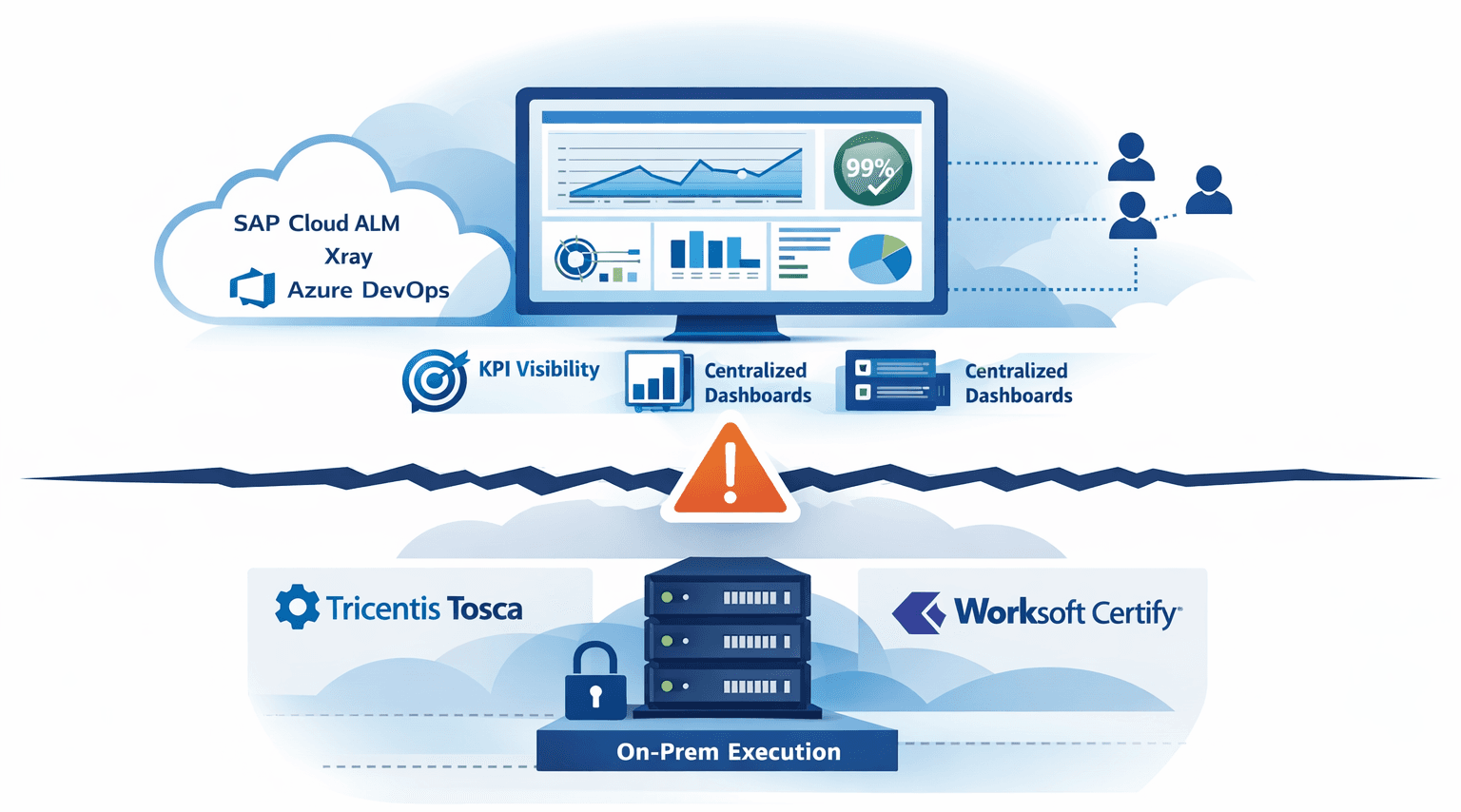
In theory, this is manageable. In practice, it introduces friction.
Results must be synchronized.
Artifacts must be attached.
Statuses must be aligned.
Execution context must be interpreted.
And the moment interpretation enters the process, governance shifts from systemic to procedural.
In many hybrid landscapes, synchronization happens through one-directional status pushes, periodic batch transfers, lightweight connectors, or manual reconciliation steps. None of these models guarantee that the SaaS dashboard reflects the native execution state at any given moment.
What appears in the cloud may be accurate. But it may also be derived.
That distinction becomes critical when release decisions are made.
The Illusion of Control
SaaS test management tools assume architectural coherence: that execution and reporting operate within the same systemic boundary.
In hybrid SAP environments, they do not.
Automation engines execute directly against SAP business processes — financial postings, supply chain transactions, and manufacturing operations. They generate runtime logs, execution traces, and detailed validation artifacts.
Those artifacts live where automation runs.
If dashboards summarize outcomes without maintaining a direct, systemic binding to execution objects and runtime artifacts, the dashboard becomes a projection layer. It represents status. It does not inherently guarantee lineage.
And release governance depends on lineage.
A green indicator may show 92% completion and 85% automation coverage. But those metrics only carry governance weight if they are directly derived from execution events — not from manually maintained status updates.
When execution and reporting are decoupled, “green” can mean “aligned.” It does not necessarily mean “verified.”
Why This Matters in SAP Environments
SAP releases are not incremental feature toggles. They affect integrated enterprise systems:
Finance and controlling
Order-to-cash
Procure-to-pay
Manufacturing execution
Regulatory reporting
A release approval decision in SAP is a risk decision. That decision should be anchored in execution truth — not in interpreted status. If automation platforms such as Tosca or Worksoft operate on-prem while Cloud systems provide governance visibility, the architecture must ensure systemic binding between those layers.
Without that binding, governance depends on procedural discipline rather than structural integrity.
Procedural discipline does not scale across complex enterprises. Most organizations don’t notice the gap — until they depend on it. Before exploring how to close it, we need to understand how it quietly reveals itself.
In next week’s article, we’ll examine why this hybrid execution gap persists — and why many so-called “native integrations” fail to close the automation feedback loop.