Test Management in the Cloud –The Gap Between “Green” and Verified - Series 2/7
Blog from 3/30/2026
Indicators of an Execution Gap
Architectural misalignment rarely announces itself through dramatic failures. More often, it appears in small operational inconsistencies — subtle signals that execution and governance are not fully aligned. In hybrid SAP landscapes, these signals tend to surface long before a release incident forces attention. Execution results may appear in SaaS dashboards without a direct reference to the underlying automation objects that produced them. Status is visible, but lineage is opaque.
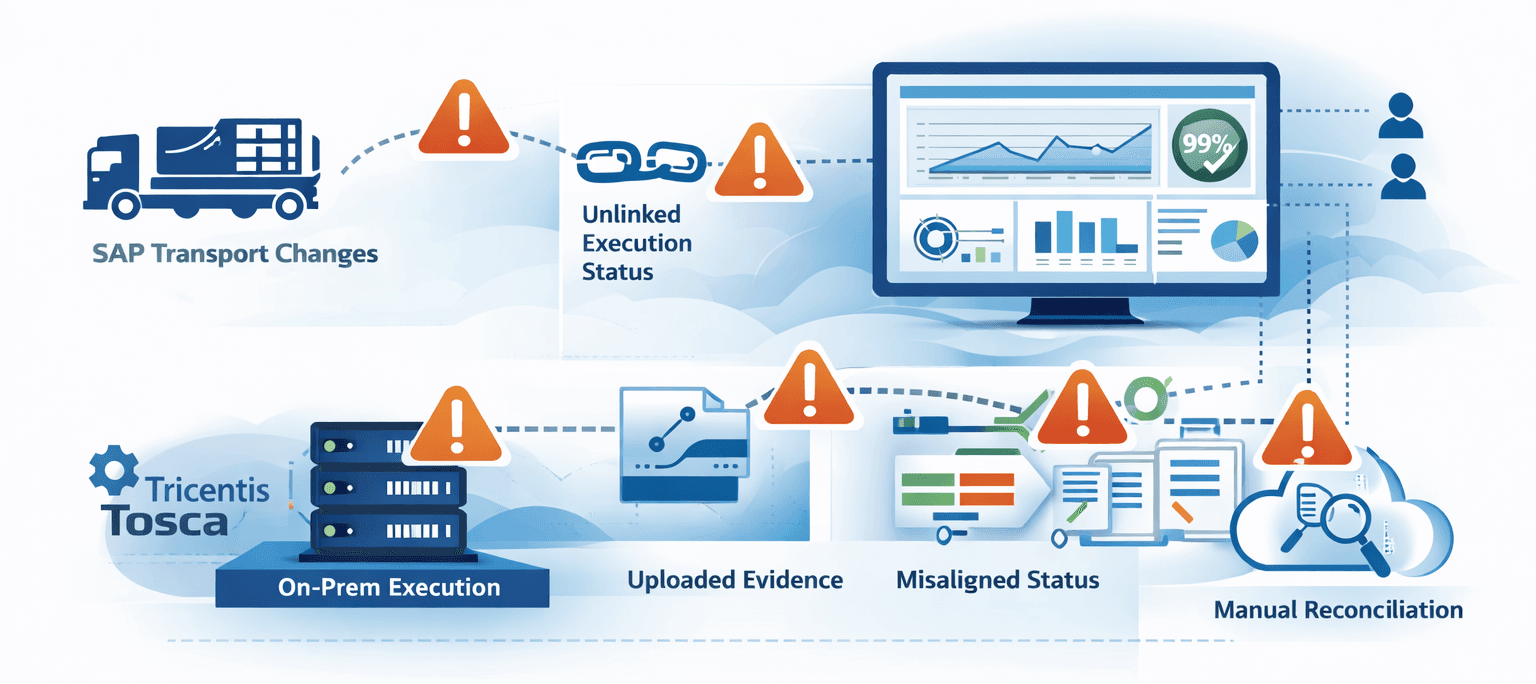
Test evidence is attached as documentation rather than generated and bound as part of the execution event itself. Artifacts exist — but their origin requires explanation. Occasional discrepancies arise between on-prem execution logs and cloud-based reporting. The numbers are close enough to avoid escalation, yet not consistently identical. Audit preparation requires cross-system reconciliation. Teams must extract, compare, and validate data across environments to demonstrate consistency.
Most critically, there is often no direct, systemic linkage between SAP transport changes and the automation outcomes intended to validate them.
Change and verification coexist — but they are not structurally connected.
Individually, none of these conditions appear alarming. Each can be resolved procedurally. Each can be explained. Collectively, however, they indicate something more fundamental.
They suggest that execution truth and reporting truth do not share a unified architectural backbone. Visibility exists, but verification depends on coordination rather than system design.
The distinction is subtle — until it isn’t.
The Governance Question or Why This Gap Survives for Years?
The execution gap in hybrid SAP landscapes is rarely the result of negligence. It persists because it is structurally convenient. Each layer of the landscape works well within its own boundary. Automation platforms execute reliably against SAP systems. Cloud-based test management tools provide visibility and coordination. Transport and release mechanisms govern technical deployment.
Individually, these systems deliver value. The friction emerges only at their intersections. And intersections are rarely owned by a single function. Automation teams focus on execution quality. SAP ALM or DevOps teams focus on reporting and workflow. SAP Basis or release governance teams focus on SAP CTS transports and system stability.
Because responsibilities are distributed, the architectural seams between systems are treated as integration tasks — not as governance risks.
Over time, lightweight integrations are implemented. Status fields are mapped. APIs are connected. Batch jobs are configured. The landscape appears connected.
Connectivity is not the same as systemic orchestration.
As long as dashboards remain mostly accurate, releases mostly succeed, and audits can be prepared with additional effort, the structural misalignment remains tolerable. It becomes normalized.
The dark forces that reinforce this normalization:
Replacing core tools is expensive and politically sensitive.
On-prem automation cannot easily move to SaaS due to network, security, or regulatory constraints.
SaaS test management is optimized for visibility, not deep execution lineage.
Organizational KPIs prioritize delivery speed over architectural purity.
The result is a stable but dangerous equilibrium.
The landscape functions. Reports are trusted — conditionally. Reconciliation is accepted as part of release preparation.
Only under stress — during major transformations, regulatory scrutiny, or high-impact incidents — does the architectural gap become visible as a systemic weakness rather than an operational inconvenience. By that point, the cost of retrofitting structural alignment is significantly higher than addressing it proactively.
This is why the gap survives for years.
Not because it is invisible. But because it is manageable — until it isn’t.
As long as visibility is mistaken for verification, the illusion holds.
Next week, we’ll unpack why hybrid testing environments create this illusion of control — and what really separates synchronized reporting from systemic truth.