SAP ALM Target Architectures After SAP Solution Manager – Series 4/6
Blog from 3/25/2026
Emerging Target Architectures
Based on the functional layers described above, two structural architecture patterns typically emerge in practice. The distinction between them does not lie in specific products, but in architectural intent and historical governance positioning.
Pattern 1: Enterprise-First SAP ALM with Integrated SAP Software Logistics
The first pattern applies when the enterprise ALM backbone is already firmly established outside the SAP domain. In such environments, tools like Jira, Azure DevOps, or ServiceNow have long been the primary systems for managing requirements, workflows, and release control. SAP Solution Manager often played a more technical role, focused primarily on transport execution.
In this model, enterprise architecture and process authority are typically anchored in platforms such as SAP LeanIX and SAP Signavio. Documentation and knowledge management are maintained in Confluence and SharePoint, or alternatively in Azure DevOps Wiki in combination with SharePoint.
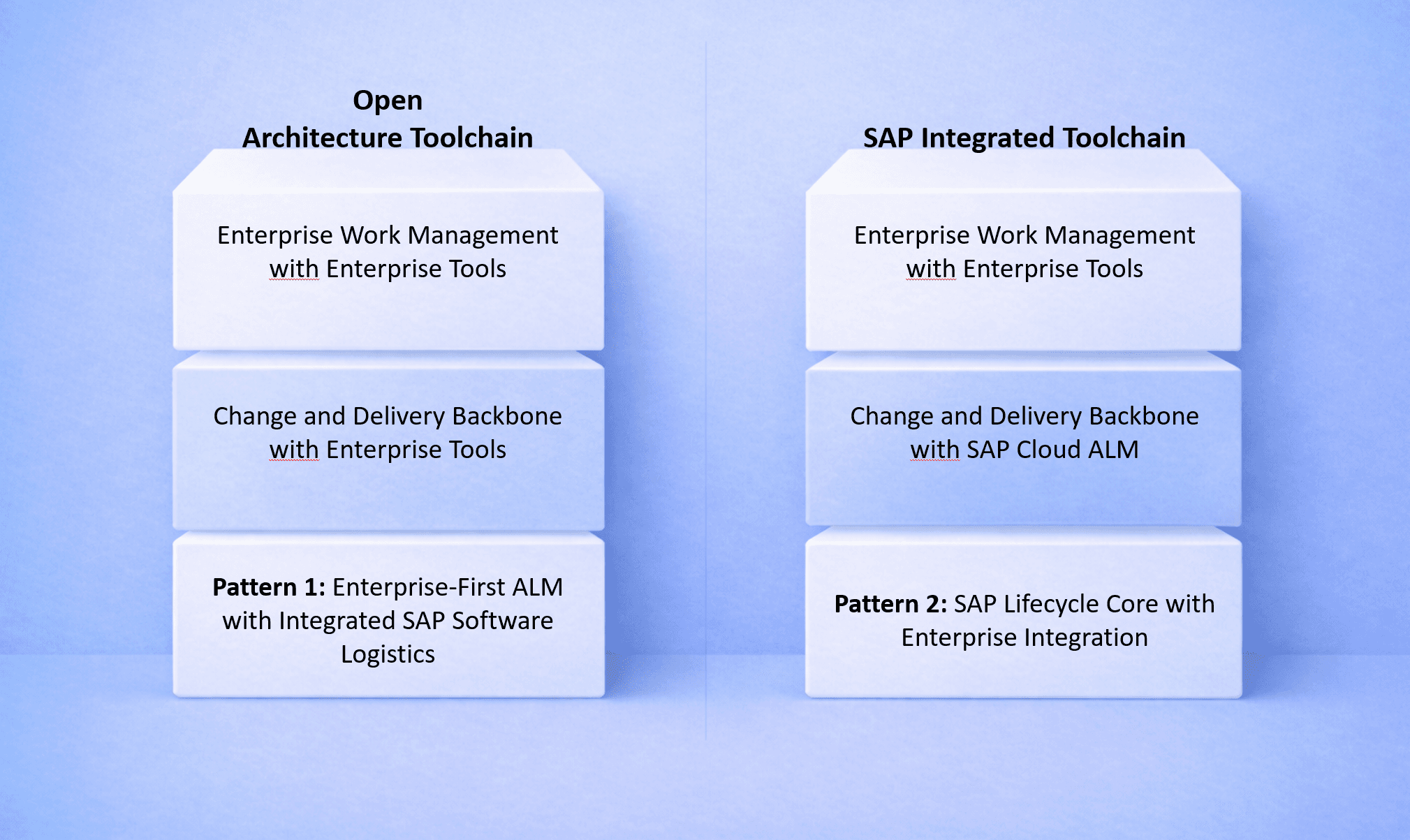
The operational change and delivery backbone remains within the enterprise toolset, for example:
Jira extended by Conigma CCM
Azure DevOps Boards extended by Conigma CCM
ServiceNow extended by Conigma CCM
Test management is aligned with the existing enterprise standards, such as Xray, Azure DevOps Test Plans, or Tricentis qTest.
In this architecture, Conigma CCM embeds SAP transport governance directly into the established enterprise backbone. SAP becomes a domain within the broader architecture rather than operating as a separate lifecycle universe.
The structural outcome is clear: governance remains unified, reporting structures stay consolidated, no parallel ALM suite is introduced, and deep SAP transport control is achieved without architectural duplication.
Pattern 2: SAP Lifecycle Core with Enterprise Integration
The second pattern typically applies in organizations where SAP governance historically remained central and deeply embedded in operational processes. In these environments, SAP Solution Manager was more than a transport mechanism; it represented a structured SAP lifecycle control layer.
Here, the target architecture becomes layered. Enterprise work management systems continue to operate at the organizational level, while SAP Cloud ALM assumes the role of lifecycle core within the SAP domain. In more complex landscapes, enhanced SAP software logistics capabilities — for example through Conigma CCM — may complement this setup to provide governance depth beyond standard feature-based transport handling.
Enterprise tools remain in place but integrate with SAP Cloud ALM. This model is particularly suited to environments characterized by strong SAP-centric compliance requirements, embedded ChaRM structures, or a high degree of SAP governance dependency.
In complex SAP landscapes with multi-track development or regulatory oversight, Conigma CCM can strengthen transport control within this layered model without fundamentally altering the architectural positioning of Cloud ALM.
In the next article, we address the factor that ultimately determines whether either pattern will succeed: integration quality.