Functional Layers in an Enterprise SAP ALM Architecture - Structural Perspective - Serie 3/6
Blog from 3/3/2026
Functional Layers in an Enterprise SAP ALM Architecture
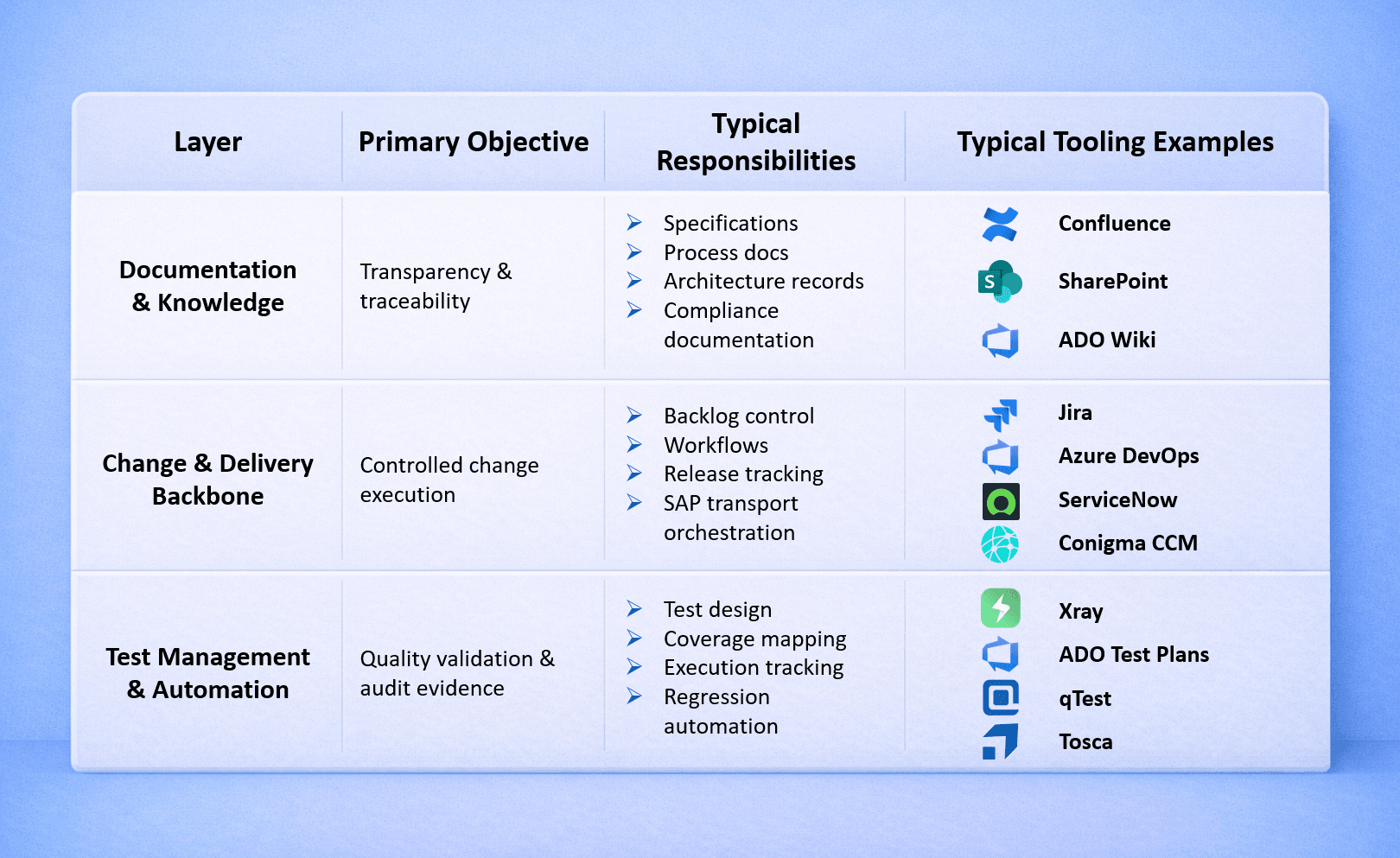
Before evaluating target architectures, it is helpful to clarify the functional layers that typically define enterprise SAP ALM. Independent of tooling decisions, these layers describe structural responsibilities within the lifecycle.
Documentation & Knowledge Layer
The Documentation & Knowledge Layer governs how structured and unstructured knowledge is maintained across business and IT domains. Its purpose is long-term transparency rather than operational workflow execution.
It typically covers:
Functional and technical specifications
Process documentation
Architecture decisions
Operating procedures
Compliance-relevant records
This layer acts as the long-term system of record. It ensures traceability across initiatives and provides contextual continuity beyond individual release cycles.
Whether implemented via Confluence, SharePoint, or Azure DevOps Wiki, the architectural function remains consistent: provide durable, searchable and auditable knowledge management across enterprise and SAP landscapes.
Change & Software Delivery Backbone
The Change & Software Delivery Backbone represents the operational core of lifecycle management. It governs how change moves from requirement to productive release.
This layer typically manages:
Requirements and backlog control
Change request workflows
Release tracking
Work assignment and approvals
Cross-system dependency management
Within SAP landscapes, it must additionally ensure:
Transport orchestration
Release sequencing
End-to-end traceability
Audit evidence linking requirements to transports
This backbone is commonly implemented in Jira, Azure DevOps, or ServiceNow. In SAP-intensive environments, it may be extended by Conigma CCM to provide deep SAP transport governance.
Architectural coherence requires that change artifacts across systems remain logically connected. Fragmentation at this level directly increases governance complexity and compliance risk.
Test Management & Automation
The Test Management & Automation layer ensures validation before productive deployment and safeguards release quality.
It includes:
Test case design
Test plan orchestration
Requirement coverage mapping
Execution tracking
Audit evidence collection
Test management platforms such as Xray, Azure DevOps Test Plans, or Tricentis qTest provide structural quality governance across enterprise domains.
Automation frameworks such as Tosca enable scalable regression testing and risk-based validation. In many enterprises, Tosca remains on-premise to minimize organizational disruption, while future migration paths toward Tosca Cloud remain open.
The key architectural requirement across this layer is bidirectional traceability:
Requirement → Change → Transport → Test Case → Test Result → Release
Without this chain, audit integrity and release confidence deteriorate.
With these layers clarified, we can now explore how they translate into concrete architectural models — and why there is no universal successor pattern.